

Hi everyone,
Today I want to share a language-learning strategy which is incredibly effective. I used this to learn Spanish and was surprised to find that I was able to hold conversations with native speakers within 1 week. This technique is comprised of two phases:
- Writing
- Speaking
Alright, let’s break it down.
Phase 1: Writing
Okay, this is the first step and is sometimes referred to as the “silent phase.” This is because we will not start speaking yet. Depending on the starting point, we may have little to no knowledge of the target language, so we’ll want to build some vocabulary. But what do we really need to know to start talking as soon as possible?
First, let’s create a set of flashcards to practice with. I recommend a free tool like Quizlet.
IMPORTANT: The chosen program has to be able to play AUDIO so we can hear the words! This is crucial for speaking and understanding the target language.
We’ll want to learn the absolute basics first, for example:
- Hello / Goodbye
- Please / Thank You
- Yes / No
- How are you? / I am fine.
- Where are you from? / I am from…
- I speak English / I am learning Spanish
- Who / What / When / Where / Why / How
After that, we’ll add some commonly used verbs to your set. These allow us to talk about ourselves and ask questions:
- I am / Are you…?
- I do / Do you…?
- I make / Do you make…?
- I like / Do you like…?
- I can / Can you…?
- I have / Do you have…?
- I know / Do you know…?
- I speak / Do you speak…?
- I think / Do you think…?
These will make up our base vocabulary. The idea is to add them to the flashcard set and go through them a few times each day WITH (!!!) the audio turned on.
But what about all the other important words? Don’t worry, we’ll get to that part later.
The next step is to find an online chat program such as Speaky or Tandem. These sites work by matching you with partners who speak your target language, and who in return can receive help from you with your native language.
Start with text-only conversations to fill in the gaps of whatever vocabulary is missing from the base flashcard set. Keep texting people and adding new words to the flashcard set.

Do this routine for 5-10 days (depending on the complexity of the language), then move to the second phase…
Phase 2: Speaking
When we’ve got some basic vocabulary down, the speaking phase can begin. If you are not comfortable having a real-time conversation yet, just leave voice notes for your partner. This feature is available for example on Speaky, WhatsApp, and Snapchat. After that, it’s time to set up a speaking session with a partner.
This is the hardest part, but the magic happens here.
Don’t get discouraged! Just stick to it even if you have to stumble and bumble all the way through it. This is completely normal and will get MUCH easier after the first conversation. While chatting, make sure to write down your partner’s words that you didn’t understand, as well as the words you wanted to say but just couldn’t think of.
We’ll use Google Translate or a similar tool while talking to our partner for two reasons: To help use if we get stuck, and more importantly to save words by clicking the star button.
After we’ve finished our session, we’ll take all those starred words and add them to our flashcards. This is how we will build upon that very limited base vocabulary that we started with.
Rinse and Repeat
Now all we have to do is continue the cycle of having spoken conversations, saving new words, adding them to the flashcard set, and removing old words that have been mastered.
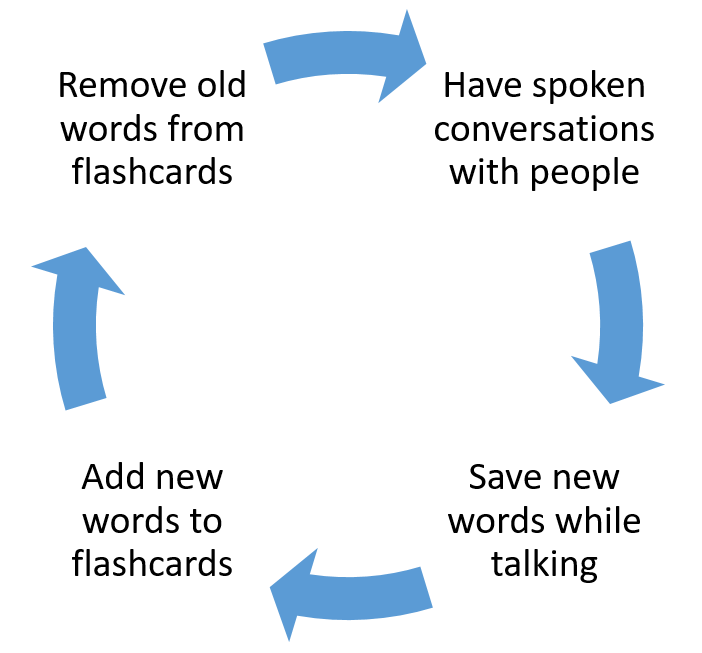
That’s it. If you keep following this pattern, you will be amazed at the results. So if you’re bored during quarantine and want something to do, try this.
What new language do you want to start? Let me know in the comments.
Happy learning!
Feature image photo by Ivan Samkov from Pexels






 The Computer Chick
1 Comment